I joined a 10-day hackathon with one simple goal: get a contribution merged. I ended up with six accepted PRs and a result I wasn't expecting.
I wasn't looking for $600 when this started.
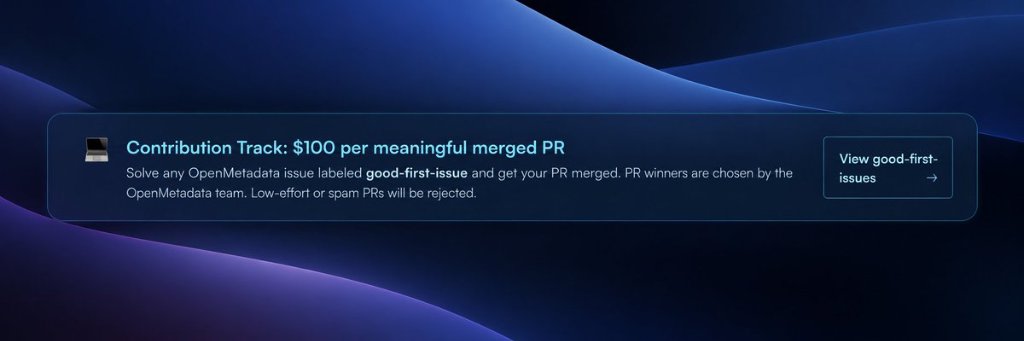
Around April 18, @siddhiguptas sent me a hackathon link and asked if we should participate. I opened the page, looked through the details, and noticed something that immediately caught my attention: $100 for every meaningful merged PR.
That was interesting.
I wasn't thinking about making hundreds of dollars from open source. I was mostly thinking, "Why not try for one?" Even one merged PR would be useful. I would get to work on a real project, learn something new, and maybe make $100 along the way.
So we registered.
I had no idea that a few days of random contribution work would eventually turn into six accepted PRs and around $600.
We Had 10 Days to Figure It Out
The hackathon was called Back to the Metadata and was focused on OpenMetadata. It ran from April 17 to April 26, so there wasn't much time to overthink things.
We decided to take the contribution route instead of trying to build another project from scratch. The idea was simple enough: find issues, understand the code, make useful changes, and get the PRs merged.
The simple part was finding the issues.
The harder part was understanding the project.
When you're working on your own code, you already know why things exist. You know the folder structure, you know where a function is being used, and you remember what you changed yesterday.
That disappears the moment you enter someone else's codebase.
You open the repository and realise there are hundreds of files, existing patterns, dependencies, and decisions that were made long before you arrived.
So we started small. We looked for issues that we could realistically handle, spent time understanding the relevant parts of the repository, and started working through them.
One PR Became Several
At the beginning, I genuinely thought we'd probably get one or two PRs merged.
Then we kept finding things we could work on.
Some changes were straightforward. Others took much longer than expected. A few needed changes after review, and some simply didn't go through. That's part of contributing to a project you don't control.
By the end of the hackathon, we had raised around 10 PRs between us, and six of them were eventually accepted.
At that point, I was already happy with the result.
I wasn't expecting some huge payout. My rough expectation was closer to three successful PRs, which would have meant around $300.
Then the hackathon ended.
And we waited.
Then Came May 6
On May 6, we received the winner announcement from WeMakeDevs.
We had won the contribution track.
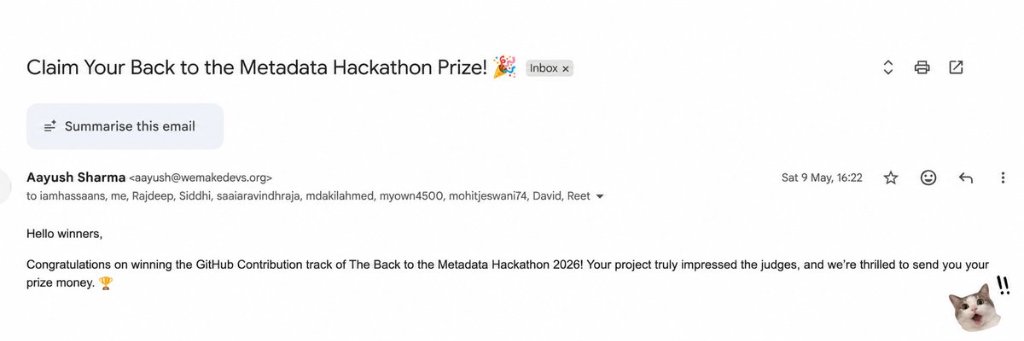
The funny part was that the email didn't mention the exact prize amount, so there was still a little uncertainty around what we'd actually receive.
We filled out the required form, submitted the payment details, and moved on.
A few days later, I got a payment notification.
I checked it once.
Then I checked it again.
Around $600.
That was not what I was expecting.
We had roughly calculated what three successful PRs would look like. Six qualifying contributions had changed that number completely.
It was one of those small moments where you look at the number again just to make sure you didn't read it wrong.
A random hackathon that started with "let's try one PR" had turned into six accepted contributions and around $600.
But the Money Wasn't the Most Interesting Part
The payout was obviously great, but after the excitement settled down, I realised that the more valuable part was the work itself.
I had spent those days inside a project I didn't build. I had to understand code written by other people, figure out how my changes should fit into the existing system, and deal with feedback from people who knew the project far better than I did.
That experience changes the way you look at software.
You start paying attention to things you usually ignore when building your own project:
- Why is this structured this way?
- Why is this logic sitting here?
- Is there already something in the codebase that solves part of this problem?
- What will this change break somewhere else?
And then there is the PR review.
You can spend hours working on something, open the PR thinking you've done a good job, and get feedback that completely changes your approach.
It can be frustrating.
It can also be one of the fastest ways to improve.
That part of the experience is difficult to get from another tutorial, another course, or another personal project where you're the only person reviewing your own decisions.
This Changed How I Look at Open Source
Before this, I mainly saw open source as a way to learn, improve my GitHub profile, and get experience.
I still think those are great reasons to contribute.
But now I look at it differently. A useful contribution can give you several things at once:
- Engineering experience: You work with an existing system instead of starting from zero every time.
- Proof of work: Your contributions are public and can be seen by other developers, maintainers, and companies.
- Connections: You naturally meet people outside your college and your usual network.
- Opportunities: Hackathons, contribution programs, bounties, and community events can sometimes lead to paid work too.
The same contribution can give you experience, a stronger portfolio, and an opportunity to meet people who can open the next door.
That is what makes open source interesting.
You Don't Have to Start with GSoC
This is probably the biggest thing I would tell a college student.
When people hear "open source", they often jump directly to GSoC, huge repositories, or major programs. Then they look at the projects and think they aren't ready.
I don't think you need to start there.
You can start with something much smaller: a hackathon, a good first issue, a contribution program, or a project that simply needs help.
That's exactly how this happened for me.
I wasn't thinking about becoming a major open source contributor. I wasn't building a six-month plan around it. Someone sent me a hackathon, I saw an opportunity to contribute, and decided to give it a shot.
That was enough to get started.
If I Were Starting Again
I wouldn't spend weeks searching for the "perfect" repository.
I'd look for an active project, check whether people are actually contributing to it, and find something that matches my current skills.
Then I'd follow a simple process:
- Find an active project.
- Read the README and contribution guide.
- Pick one issue you can realistically understand.
- Read the related code before changing it.
- Make one useful contribution and learn from the review.
The goal isn't to create ten random PRs just to make your profile look busy.
The goal is to make one contribution that the project actually wants.
Once you get that first PR merged, the whole thing feels different. You're no longer looking at open source from the outside.
You're part of it.
The Funniest Part of the Whole Story
If someone had told me on April 18 that we would end the hackathon with six accepted PRs and around $600, I probably wouldn't have believed them.
There wasn't some perfect strategy behind it.
It was more like:
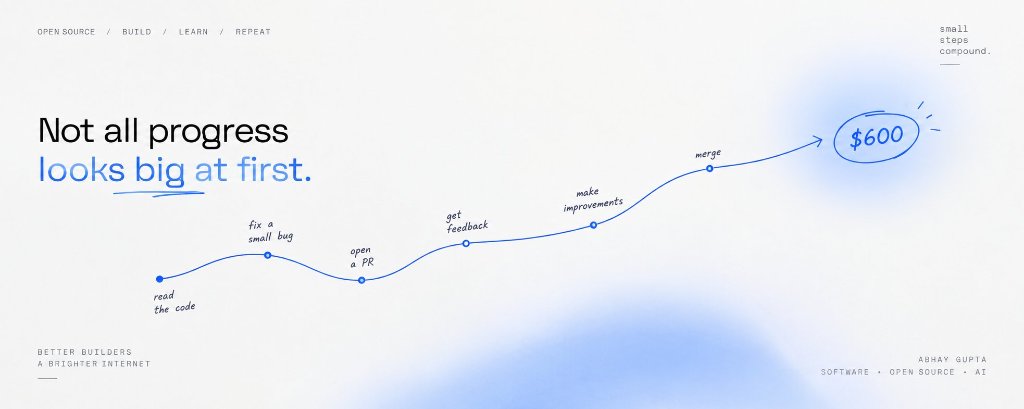
Random hackathon ──> One contribution ──> More issues ──> ~10 PRs ──> 6 accepted ──> $600
And that's probably why this experience stuck with me.
I didn't start with the goal of making money from open source. I started because I saw something interesting and thought it was worth trying.
The money was a very nice surprise.
The bigger win was realising that open source has much more to offer than a contribution graph.
There are projects to learn from, people to meet, problems to solve, and opportunities that you simply won't see until you start participating.
I opened that hackathon expecting maybe one merged PR.
Six ended up getting accepted.
And somehow, that turned into around $600.
Not a bad outcome from one random link and a simple:
"Let's try it."